
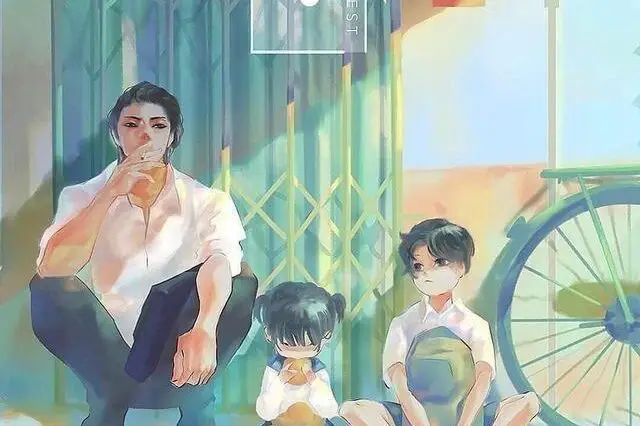
大哥 by Priest
Bro | Chapter 1
by ee_xee3To cry in the manner of laughing, to live accompanied by death. Yu Hua, To Live.
He dreamed that he was still very small, about five or six years old, sitting at the head of the bed, with a hot radiator on one side and a woman beside him on the other.
The woman had a big belly. He did not dare lean his full weight against her, so he only let his tilted head rest lightly against her arm, creating the illusion of closeness and dependence.
That woman was truly beautiful. Compared with those hugely famous stars on television, she was in no way inferior, with an oval face, fair skin, and neat, well-shaped features.
She held a battered old book in her hand and was carefully reading aloud the story printed on it.
The woman did not seem to have much education, and her reading ability was quite limited. Even simple fairy tales with plain wording came out haltingly when she read them, and she often paused in places that made the sentences confusing. Yet she seemed rather pleased with herself. One hand held the book, the other rested on her own belly. Her voice was sweet and clear, and her expression was calm and lovely.
“…The children walked together to the other side of the mountain and discovered a little stream. The stream ran merrily from east to west, splashing as it said, ‘Foolish children, here there are fragrant cakes, golden roast chicken, candies beyond counting, hanging from the trees in every color, like stars in the sky, impossible to finish picking. There is also a man-eating monster here, waiting to raise you into plump little lambs and swallow you whole in one bite.’”
“At first, all the children were frightened stiff and did not dare step across. They lived on this side of the stream, surviving on wild mushrooms and wild strawberries. The wild mushrooms were bland and tasteless, and the wild strawberries were sour and unripe. At last, one day, the oldest boy said to himself, ‘I can’t stand it anymore. How wonderful it would be if I could eat the cakes and roast chicken on the other side, and all those countless candies too.’”
“He was the first to jump across the stream and feast his fill in the beautiful woods. At night he jumped back to this side of the stream and told everyone that there was no man-eating monster in the woods. So the next day, the oldest girl also said to herself, ‘How wonderful it would be if I could eat the cakes and roast chicken on the other side, and all those countless candies too.’ That very day, she followed the first boy and jumped across the stream with him, feasting her fill in the beautiful woods. That night, the two came back together and declared that they still had not encountered any man-eating monster.”
“One after another, the boys and girls jumped across the stream to enjoy the feast on the other side. A day passed, and the man-eating monster did not appear. A month passed, and the man-eating monster still did not appear. They loudly mocked the rushing, unceasing stream, then all went to live on the other side of it, roaming freely through the beautiful woods every day, eating exquisite food and countless candies. Only the youngest boy remained where he was. No matter how his companions, growing fatter and fatter, shouted and waved from the opposite bank, he stubbornly refused to go even one step closer.”
“Every day, the children who had crossed the stream shouted to their little friend, ‘Hey, come over here. The stream is lying. There’s no man-eating monster here. Life here is like paradise!’ But the youngest boy remained unmoved. He still lived on mushrooms and wild strawberries. He remembered what his grandmother had told him before he left home, there is no such thing as a free lunch, and comfort that comes for no reason is the most frightening trap in the jungle.”
“Then suddenly, one night, the youngest boy heard a shrill roar. He was startled awake. When he opened his eyes, he discovered that the stream had swollen, splitting the land into two halves and turning into a vast expanse of water.”
“The vast waters sang loudly, ‘Little lambs, little lambs, round and plump, one bite and down you go, not one of you will get away!’ The youngest boy rubbed his eyes and saw his companions being chased by a monster as huge as a mountain. But they were too fat, and could not run fast at all. Before they could even reach the water’s edge, they were caught one by one and eaten. They had all fallen into the most dangerous trap. Only the youngest boy escaped the disaster and passed this story down.”
The yellowed page turned. The story, with neither beginning nor ending, was finished. As if she had completed some enormous undertaking, the woman let out a breath and said carelessly to Wei Qian, who was leaning against her, “So that’s why people can’t live too comfortably. Once you’re stuffed to the gills and spending every day full and idle until dark, you’re not far from croaking…”
Her pleasant yet coarse voice was cut off by a shrill ringing. As if startled, Wei Qian abruptly opened his eyes and sprang up from the bed.
It was five-thirty in the morning, and the sky was not yet fully bright.
Wei Qian was still immersed in the dream just now. It was a beautiful dream, and also a nightmare.
Carrying the low-pressure gloom of too little sleep on his face, he hauled himself up with difficulty like a dead dog, grabbed a slipper, and smacked to death a cockroach strutting across the head of his bed. Then he hopped on one leg over to the water pipe, rinsed the sole of the slipper clean, and, with slapping footsteps, washed his hands, rinsed the rice, and put on porridge in a dented little pot.
Then he stuck his head out the window and saw that the breakfast stall run by Ma Zi’s mother family downstairs was already set up, the oil heating in the wok.
Wei Qian let out a long whistle toward downstairs, not caring at all if he woke the neighbors, and shouted, “Ma Zi, three youtiao for your brother here!”
The moment he finished yelling, the upstairs window also opened with a creak, and a fat guy with a toothbrush in his mouth mumbled indistinctly, “Six for your brother, and pick the thickest, biggest ones for me!”
The one shouting was San Pang from upstairs. This guy was already as round as a ball, yet still stubbornly took pride in being a glutton. The lofty level of his thinking was practically transcendental.
Wei Qian felt that three compared with six was seriously lacking in heroic spirit, so he tipped his head back and shouted to San Pang, “Pig, you’re really enthusiastic about getting sent to slaughter. That’s some impressive ideological awareness!”
San Pang’s mouth was full of toothpaste foam, and he had no time to bother with him, so in the midst of his busy schedule he could only stretch out one pig trotter and spare Wei Qian a middle finger.
Ma Zi’s father had died long ago. He was an orphan living with his widowed mother, and she made a living selling breakfast. Every morning, Ma Zi had to get up and help his mother fry youtiao. Hearing his friends bicker like dogs at the crack of dawn was something he was thoroughly used to.
He wiped his hands on his apron and, without saying anything, grinned and waved to the two gentlemen upstairs to show that he had heard. Oh, Ma Zi was a stutterer, and generally did not hold forth in public.
With breakfast settled, Wei Qian charged off to the bathroom as if going to war, brushed his teeth and washed his face, and began his busy, miserable day.
He set the cooked porridge aside to cool while getting himself ready, then ran downstairs with some change to fetch the youtiao. After that, he came back up to wake his younger sister, Xiao Bao, watched her finish breakfast, carried her upstairs, and handed her over to San Pang’s mother to look after. Before leaving, he even smacked away Xiao Bao’s hand when she tried to stuff more food into her mouth.
Then Wei Qian pedaled his broken-down bicycle toward school.
This day was the day Wei Qian would take the high school entrance exam.
Wei Qian had never known who his father was. He did not even know how many noses or eyes that man had. The only concept he had of him was that the guy was a scumbag bastard, and that came from his mother repeating it in his ear day after day, year after year, for ten straight years.
Rumor had it that the shameless old bastard was still rotting in prison, bearing the grand, awe-inspiring, reeking-for-ten-miles glorious title of “rapist.” Who knew in what year or month he would finally get out. Of course, Wei Qian did not hope for that either. An old ex-con who could not even fart straight, once released, would only be a burden on society.
Wei Qian thought it would be best if the old bastard got beaten to death in prison by the other inmates before his sentence was up.
One of the victims created by that old ex-con was Wei Qian’s mother. Oh, right, and Wei Qian himself, an indirect victim too.
When his mother was young, her head was full of mush. Back then she had not behaved herself, running around every day with a bunch of little hoodlums, stumbling drunk through the streets in the middle of the night. Unfortunately, that old ex-con set his sights on her, and she became a victim in a muddled haze. Later, in another muddled haze, she got pregnant and gave birth to Wei Qian.
So, speaking rationally, Wei Qian understood why his mother had disliked him ever since he was little. He felt that the fact she had not simply strangled him to death when he was born was already the work of hormones. Hormones truly were the miracle of human life.
Not to mention that, somehow, she had still half-heartedly dragged him up into childhood.
Even so, Wei Qian still hated her from the bottom of his heart.
He hated her every single day, on schedule and at fixed times, as though punching a clock. He hated her so much he wished he could eat her flesh and drink her blood.
And yet, from the bottom of his heart, he also longed for her to give him a little warmth. On the rare occasions when she really did, Wei Qian would feel enormous happiness. Because of that, he hated himself too. He believed his genes were bad, that he had been born with a streak of cheap, mean weakness in his bones.
The woman always slept by day and moved by night. The work she relied on to make a living was ancient and traditional, with a shameful history of several thousand years in our country. It was a job that had brought Wei Qian endless “glory.” His mother was a “chicken.” In the shameless bitch’s own words, the good thing about this line of work was that she got to screw men for free and still make them pay her.
Wei Qian’s rapist father had ended her entire girlhood and blackened her through and through, making her even more brazen and shameless.
And as a “chicken egg,” Wei Qian’s childhood was one long torment.
Every night, his mother went out cursing and swearing, and did not come back until the next morning. She would use her long fingernails to pinch him painfully awake through the quilt. If she was in a good mood, she would curse him together with his parents and all his ancestors. If she was in a bad mood, she would also slap him a couple of times as a matter of course, then, reeking of alcohol, order little Wei Qian, who was not even as tall as the stove, to fix her something to eat.
Several times, Wei Qian had already bought the rat poison and was prepared to put it in the food and die together with her. But in the end, he never went through with it, because when that woman occasionally tried to act like a mother, she would wrap him in her soft arms and watch television with him for a while. If she was in a good mood, she would even speak softly into his ear.
If she had earned quite a bit during the night, she would even buy Wei Qian two jianbing guozi on her way home in the morning.
Although this kind of thing was precious and almost impossible to come by, it was always enough to make the young Wei Qian feel overwhelmed by the favor. At times like that, he no longer wanted to kill this woman, because he would also remember that she was his real mother.
His real mother was more beautiful than any woman he had seen in his life, yet she had not brought him a shred of glory.
But in all the world, there was only this one person who was his real mother. If he killed her, then she would be gone. He could not bear it.
And so the two of them lived on like that, hating each other while depending on each other for survival.
When Wei Qian was five years old, his mother married again. His stepfather was an honest man who did not earn much and was not particularly capable. He was not especially warm toward this cheap stepson either, but he had never abused him.
Later, probably because he found Wei Qian an eyesore around the house, when Wei Qian had just turned six, his stepfather took the initiative to send him to primary school, riding him there on a big old bicycle to register.
Wei Qian called him Uncle.
After Uncle came, his mother put down the butcher’s knife and instantly became a Buddha, almost overnight. She never went out fooling around again. Practically at once, she washed the paint off her face, pinned up her long hair high, never touched another drop of alcohol, and her temper improved a great deal too.
With one transformation, she became a normal woman and a normal mother.
That winter, she even knitted Wei Qian a sweater by hand. He only wore that sweater for one winter. The next year he had already grown too fast to fit into it, but Wei Qian always kept it carefully in the cabinet, because it was almost the only gift he had received in his childhood.
People always say that children of six or seven roll around everywhere and are such a nuisance that even dogs hate them, but when Wei Qian was six or seven, he was as docile as a dog. He never said a word more than necessary and never made demands. If adults did not voluntarily give him money, he would never open his mouth to ask them for any. Sometimes the school needed students to pay for something. Wei Qian would first borrow from others, then go to the pool hall or arcade by himself and do odd jobs for people there, earning a few yuan to pay them back.
In the process, he got to know many little hooligans much older than he was. The boss thought it was amusing to watch such a small child run around picking up balls and carrying trays. On top of that, Wei Qian had good instincts and was extremely good at reading faces, so they kept him around as a rare sort of lucky mascot to tease when they had nothing better to do.
Wei Qian enjoyed this very much and did not find it painful, because at school he had learned that he too was one of the motherland’s budding flowers. This kind of life left him quite satisfied.
Because of that, he was always terrified of making his uncle unhappy, terrified that his uncle and mother might divorce and he would be thrown back into those days of living worse than a pig or a dog.
When Wei Qian was seven and a half, not yet eight, his mother gave birth to another girl.
The girl looked as if she had been cast from the same mold as his uncle. In other words, she was ugly. Even so, the whole family treasured her beyond measure.
She was born in spring. Her parents thought names like “Chun” or “Liu” were too rustic and unworthy of their precious daughter. It was no easy thing for his mother and uncle, whose education did not add up to even nine years between them. After putting their heads together for more than a week, they finally racked their brains and came up with what they thought was a poetic name for the little girl, Song Lili.
She took Uncle’s surname, Song, and “Lili” from the “lili” in “Lili yuanshang cao.” Her pet name was Xiao Bao.
But Wei Qian almost never called his little sister by that unlucky formal name. Right up until she was grown, he always called her “Xiao Bao.”
Instead of “gathering,” they had to choose “parting.” Who had ever heard of giving a child a name like that? Truly, the very picture of auspiciousness.
His biological mother and stepfather, both illiterate, were so obsessed with “poetic feeling” that they gave the child a name like that. They were simply asking for trouble out of sheer boredom.
That inauspicious name would accompany the little girl for her whole life. It seemed to foretell that parting in life and separation in death would run from beginning to end through her fragile existence.
TL/N:
Song Lili : (宋莉莉) “Song” is the surname taken from her uncle, while “Lili” comes from the “li li” (莉莉) in the phrase “lili yuanshang cao” (离离原上草), a poetic expression describing lush, flourishing grass.
Xiao Bao : (小宝) A pet name meaning “little treasure,” used as an affectionate nickname.